Top Storm Door Manufacturers and Suppliers Worldwide
Storm doors add a practical layer between a home’s entry and changing outdoor conditions. They can help protect an exterior door, support ventilation, and keep insects out when the main door is open. The right choice depends on more than appearance. Frame material, glass or screen options, hardware, weatherstripping, and installation dimensions all matter.
Worldwide manufacturers and suppliers serve different climates, building styles, and purchasing needs. Some focus on standard residential models, while others offer custom sizes, replacement parts, or products for distributors and contractors. Availability and specifications vary by market, so buyers should confirm measurements, materials, warranty terms, and local service before ordering. Small details matter. A poorly fitting frame can leave gaps, while a screen that is difficult to replace may become a frustration later.
This guide introduces notable storm door manufacturers and suppliers, along with the qualities that can help distinguish their offerings. It considers product range, construction, customization, and customer support without treating any single brand as right for every home. Product descriptions and supplier information can change, and published claims may not answer every practical question. That is worth remembering. A careful comparison should include clear specifications and, where possible, direct confirmation from the supplier. The best option is usually the one that fits the opening, climate, budget, and expected use—not simply the one with the most features.
Storm Doors Defined: Core Components, Functions, and Common Operating Styles
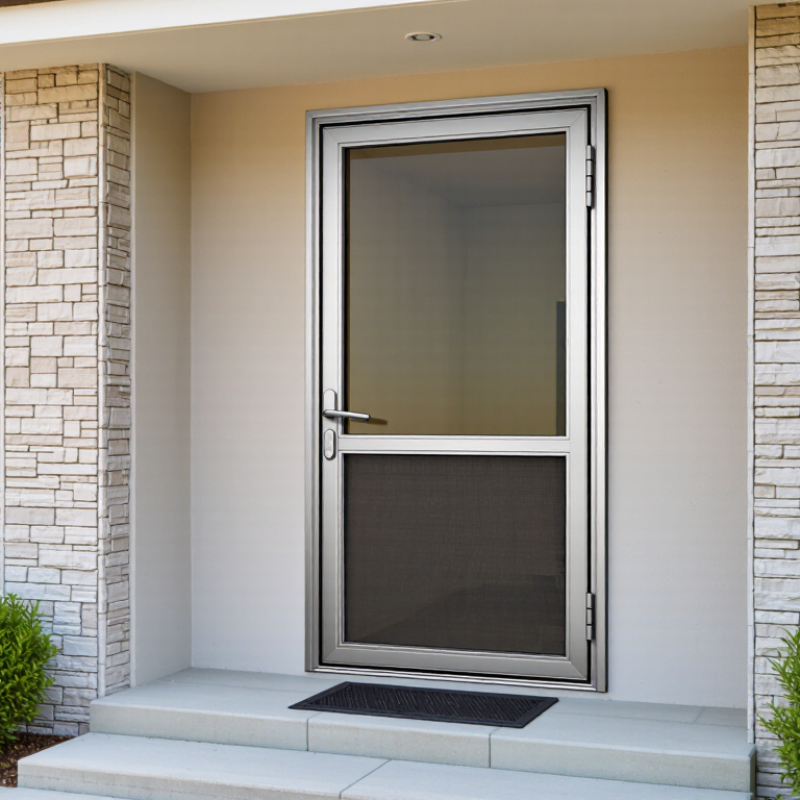
A storm door is an outer layer fitted over an existing entry door. Its frame holds glass or screen panels, while hinges, a handle, latch, closer, and weatherstripping control movement and gaps. A bottom sweep and threshold help limit drafts, rain, and debris. Small parts matter. A loose closer can let the door slam; worn seals can leave a visible strip of daylight. The U.S. Energy Information Administration’s 2020 Residential Energy Consumption Survey found that space heating accounted for about 42% of household energy use. That figure is not a storm-door savings estimate, but it explains why controlling drafts can matter in cold-weather homes.
Operating styles vary with climate and daily use. Full-view models use a large glass panel, often with a removable or interchangeable screen for seasonal ventilation. Half-view designs keep glass above a solid lower panel, which can better tolerate scuffs from pets or busy entryways. Retractable-screen versions store mesh inside the frame when not needed. Hinged doors are common; some models offer reversible installation to suit the entry layout. Still, a well-made door can disappoint if the frame is out of square or the sweep misses the sill. The fit is less glamorous than the glazing, but often more important. Manufacturers’ specifications should be checked for panel-change methods, hardware adjustment, and installation clearances.
Frame and Panel Materials: Comparing Aluminum, Wood, and Vinyl
Storm-door frames face rain, grit, and repeated handling, so material affects more than appearance. Aluminum supports narrow profiles and resists rot, but conducts heat readily. ASHRAE Handbook—Fundamentals places aluminum’s thermal conductivity near 200 W/m·K, far above rigid PVC at roughly 0.16 W/m·K. A thermally broken frame can reduce that heat path; without one, a cold frame may feel chilly indoors. Small detail, big difference.
Wood offers a warm look and can be sanded or repaired, but exposed edges need regular sealing. The USDA Forest Products Laboratory’s Wood Handbook explains that wood conductivity varies with species, grain direction, and moisture. That variability matters: a wet, dense frame may perform differently from a dry, light one. Vinyl frames require little painting and resist moisture, though expansion in strong sun can affect fit. Check reinforcement and corner joints, not just the surface finish.
Panels matter too. Aluminum and vinyl frames commonly pair with glass or removable screens, while wood frames allow flexible repairs and finish choices. Ask suppliers for measured frame dimensions, glazing thickness, drainage details, and test data for air leakage. A low-maintenance claim alone is thin evidence. Compare the whole assembly, because a sound frame can still leak around a poorly fitted panel.
Storm Door Frame Materials: Typical Material Density
Aluminum is approximately 2,700 kg/m³ and PVC vinyl approximately 1,380 kg/m³. Wood varies considerably by species and moisture content; 600 kg/m³ is shown as a representative value within a broad typical range of roughly 400–900 kg/m³. These are material densities, not the weight of a finished storm door.
Performance Benchmarks: NFRC U-Factor and SHGC Ratings
For buyers comparing storm door manufacturers and suppliers worldwide, NFRC ratings can provide a consistent starting point. U-factor measures heat transfer through a product; lower values generally indicate better insulation. SHGC measures how much solar heat passes through glazing. A lower SHGC can help limit unwanted heat gain, especially on sun-exposed entrances. Small differences matter.
Check that ratings apply to the exact model and glazing option being quoted. A supplier’s catalog may show several configurations, and one number cannot represent them all. Compare products with similar frames, glass, and operating features. Also confirm whether an NFRC-certified rating is available; storm doors do not all carry the same published data. If figures are missing, ask for documentation rather than assuming performance from appearance.
Ratings are useful, but incomplete. A tight-fitting door with a well-sealed threshold may perform differently from one installed with visible gaps. Exposure, the condition of the main entry door, and local weather also affect results. This is easy to overlook. Use U-factor and SHGC to screen options, then review installation details and product specifications before choosing. A rating should inform the decision, not make it alone.
Air-Leakage Testing: ASTM E283 Measurements in cfm/ft² at 75 Pa
For storm door buyers, an air-leakage figure can reveal more than a product description. Under ASTM E283, air passing through a tested assembly is measured at a stated pressure difference. At 75 Pa, results are often reported in cfm/ft², or cubic feet per minute per square foot. Lower values indicate less measured leakage under those test conditions.
Ask suppliers for the report, not just a catalog number. Check the tested door size, frame, glazing, sweep, and latch settings. A small change at the bottom edge can affect the result. Confirm that the reported area basis is clear, since inconsistent calculations can make comparisons misleading. Details matter.
A laboratory result is useful, but it cannot predict every installation. An uneven sill, loose fasteners, or compressed weatherstripping may create gaps that testing did not capture. Installation quality counts. Compare products tested using the same pressure and method, and treat missing test details as a reason to ask questions. Even a precise number has limits; real homes are less tidy than test chambers.
Top Storm Door Manufacturers and Suppliers Worldwide - Air-Leakage Testing: ASTM E283 Measurements in cfm/ft² at 75 Pa
Data note: The anonymous records below are illustrative examples, not manufacturer-specific measurements or certified test results. ASTM E283 is a test method for measuring air leakage through exterior windows, doors, and similar products under a specified static pressure difference. Leakage per unit area is calculated as measured airflow divided by specimen area.
| Sample ID |
Storm Door Configuration |
Specimen Size (in.) |
Specimen Area (ft²) |
Test Pressure (Pa) |
Measured Airflow (cfm) |
Air Leakage (cfm/ft²) |
Calculation |
| SD-01 |
Full-view, single-sash, compression-sealed |
36 × 80 |
20.00 |
75 |
2.00 |
0.100 |
2.00 ÷ 20.00 |
| SD-02 |
Mid-view, interchangeable glass and screen panels |
32 × 80 |
17.78 |
75 |
1.78 |
0.100 |
1.78 ÷ 17.78 |
| SD-03 |
Ventilating, two-panel sliding design |
36 × 84 |
21.00 |
75 |
2.52 |
0.120 |
2.52 ÷ 21.00 |
| SD-04 |
Full-view, continuous perimeter weatherstripping |
34 × 80 |
18.89 |
75 |
1.80 |
0.095 |
1.80 ÷ 18.89 |
| SD-05 |
Retractable-screen, hinged configuration |
36 × 80 |
20.00 |
75 |
3.00 |
0.150 |
3.00 ÷ 20.00 |
| SD-06 |
Full-view, reinforced frame, compression-sealed |
36 × 80 |
20.00 |
75 |
1.20 |
0.060 |
1.20 ÷ 20.00 |
Units: cfm = cubic feet per minute; ft² = square feet; Pa = pascals. Values are normalized to specimen area at 75 Pa. Actual test reports should identify the tested specimen, test setup, pressure direction, and laboratory.
Leading Global Manufacturers and Suppliers: Product Ranges and Regional Markets
Storm door manufacturers commonly offer full-view, mid-view, and ventilating models. Full-view designs pair a large glass panel with a removable screen for seasonal airflow. Mid-view doors have a solid lower section that can better handle scuffs from shoes or garden tools. Some suppliers also provide custom sizes, interchangeable panels, and matching hardware. Fit matters.
Regional markets influence product choices. In North America, homeowners often seek interchangeable glass and screen panels for changing seasons. Colder regions may favor tighter seals and durable finishes that resist moisture and temperature swings. European suppliers may offer configurations suited to local door dimensions and architectural preferences. In parts of Asia and the Middle East, ventilation, shading, and compact openings can shape demand. These are broad patterns, not rules for every buyer.
When comparing suppliers, check frame material, glazing options, screen availability, lead times, and replacement-part access. Ask for installation dimensions and finish-care guidance before ordering. A wide catalog can look reassuring, but it does not guarantee that a replacement screen will be easy to source. Regional distributors may stock only selected configurations, too. Confirm details in writing, especially for custom orders.