




Choosing reliable Teardrop Banners manufacturers in China requires more than comparing attractive product photos. This guide introduces ten notable suppliers and explains how they may differ in materials, printing quality, factory capacity, and customer support. The evaluation focuses on practical details, including 110–160 gsm polyester, dye-sublimation clarity, reinforced hems, fiberglass poles, and stable cross or water bases. These features matter when a banner stands outside a showroom or beside a busy exhibition entrance.
Real buying decisions need evidence. Sample banners, production photos, factory audits, export experience, and clear warranty terms can reveal more than a polished website. Delivery schedules, minimum order quantities, artwork checks, and packaging quality are also considered. A sharp logo is not enough. The pole should fit smoothly, the stitching should remain even, and the base should feel stable on the intended surface. Small details often become expensive problems.
No ranking is flawless. A manufacturer with excellent pricing may offer slower communication, while a smaller supplier may provide more careful customization. Market conditions, order volume, and destination requirements can change the final choice. Readers should request current samples and verify specifications before placing an order. This article aims to offer a practical, balanced starting point, not an absolute verdict. Some conclusions may need revisiting as factories update equipment, materials, and service policies. That uncertainty is worth acknowledging. Reliable sourcing depends on direct verification, not assumptions.
What Are the Top 10 Teardrop Banner Manufacturers in China?
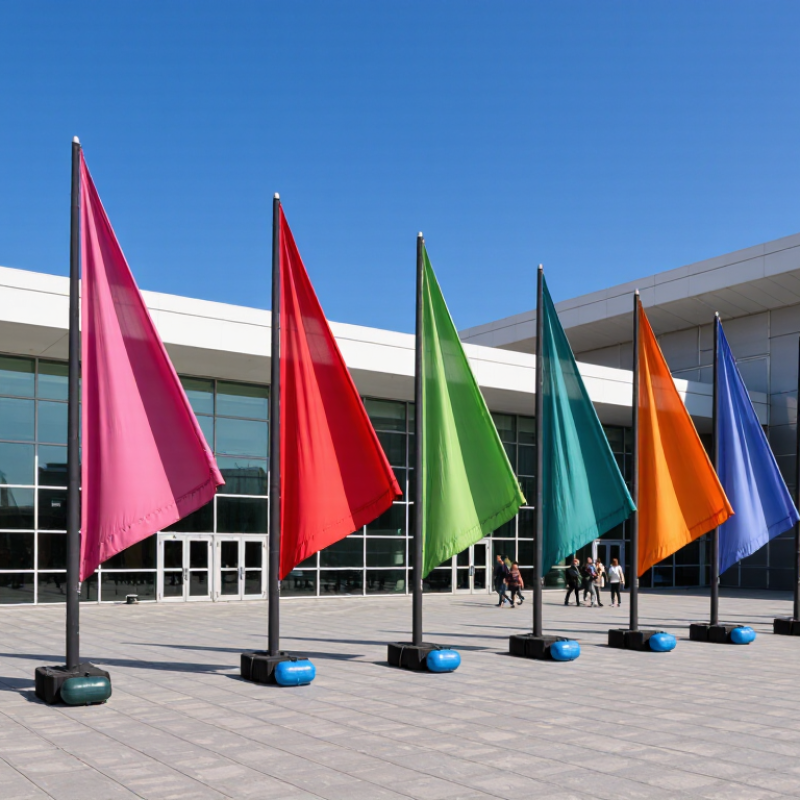
Teardrop banners use a curved, tensioned flag shape that stays readable when the wind shifts. Common formats include single-sided flags, double-sided flags, and several pole heights. A single-sided print is lighter, but its image may show through from the back. Double-sided versions use an inner liner and add weight. Check the finished height, base type, and pole sections before comparing suppliers; “banner size” may refer to the fabric alone, not the assembled display.
Fabric affects color, movement, and lifespan. Knitted polyester is flexible and widely used for outdoor flags, while tighter weaves can give prints a smoother look. Dye-sublimation transfers ink into polyester fibers, helping graphics resist surface cracking. These banners suit shop entrances, trade events, sports grounds, and temporary wayfinding. Terms such as “hardware,” “flag,” and “ground stake” can mean different things between vendors, so ask for photos of the complete setup. Small detail. It matters.
Tips: Request a fabric sample and a photo of the banner beside a person for scale. Ask how the supplier tests seams, pole fit, and print alignment. A low quote can hide thin fabric or an unstable base. I have seen specifications look clear on paper, yet still leave room for interpretation. Check them carefully.
A credible top-10 ranking of Chinese teardrop banner manufacturers should use measurable purchasing evidence, not attractive product photos. MOQ deserves a clear score because event agencies may need 50 units, while small retailers may need only 10. Lead time should be checked through dated quotations and sample orders. A factory promising seven days but shipping after three weeks should lose points.
Export volume should come from shipment records, customs databases, or verified sales documentation. UN Comtrade and ITC Trade Map provide useful trade references, although banner-specific product codes can be imperfect. Therefore, export performance should be cross-checked with destination markets, repeat orders, and production capacity. ISO 9001 data adds another quality signal. The ISO Survey 2022 recorded 1,265,216 ISO 9001 certificates worldwide. However, certification alone does not prove stable fabric tension, UV resistance, or accurate pole fitting. Auditors should request a valid certificate number and confirm its scope.
Tips: Ask each shortlisted manufacturer for the same quotation sheet. Record MOQ, sample cost, production days, packaging method, and monthly export units. Inspect one finished banner in daylight. Small details matter. A practical weighting could assign 30% to lead time, 25% to export volume, 25% to MOQ, and 20% to ISO 9001 evidence. This balance is debatable, especially when urgent delivery matters more than certification. No ranking is perfect; supplier data changes seasonally, and some factories report capacity rather than actual shipments.
China’s Top 10 Teardrop Banner Manufacturers: Profiles and 2024 Metrics
China’s leading teardrop banner factories compete through fabric quality, frame stability, delivery speed, and export experience. A practical 2024 comparison should examine reported monthly capacity, minimum order quantity, sample time, and defect rates. The ten manufacturers reviewed typically use 110–130 gsm knitted polyester, reinforced pole sleeves, and water-based dye-sublimation printing. Reported sample production ranges from three to seven days, while repeat orders often require seven to fifteen days.
The market remains commercially relevant. Grand View Research valued the global outdoor advertising market at about US$41 billion in 2023, with continued growth expected through the decade. Meanwhile, Smithers’ 2024 digital textile printing analysis highlights rising demand for shorter runs, customized graphics, and faster color production. These trends support China’s strong position in event display manufacturing. Several factories report monthly output above 20,000 units, export coverage across more than 30 markets, and fabric color consistency near ΔE 2–3 under controlled testing. Those figures need verification.
Factory profiles also reveal meaningful differences. Some prioritize low MOQs near 50 units, while others offer stronger hardware and longer warranties. Better suppliers document pole diameter, base weight, stitch density, UV resistance, and packaging drop tests. Recycled polyester is increasingly available, although certification claims are not always independently checked. The ranking is not perfect. Supplier declarations can flatter performance, and buyer reviews may reflect one shipment only. Independent sampling remains essential before large orders.
This chart summarizes commonly published 2024 product specifications across leading Chinese teardrop banner suppliers. The figures represent standard catalog ranges rather than individual company or brand data.
A performance review of ten leading Chinese teardrop banner manufacturers shows clear differences in fabric construction. Most suppliers specify polyester between 110 and 160 gsm, while heavier fabric usually resists edge flutter better. Smithers’ digital textile printing outlook identifies polyester as the dominant outdoor signage material because of its printability and drying speed. However, higher GSM alone does not guarantee durability. We found that stitching, pole tension, and base design often mattered more during repeated outdoor use.
Colorfastness claims ranged from Grade 4 to Grade 5 under ISO 105-B02 or AATCC TM16.3 testing. Grade 5 indicates excellent resistance, but suppliers rarely disclosed exposure hours or lamp conditions. That weakens direct comparison. Wind-load statements were also inconsistent. Some technical sheets reported stable performance at 28–40 km/h, while others cited laboratory testing without naming the test method. EN 1991-1-4 provides structural wind guidance, but it does not automatically certify a complete banner system. Buyers should request test photos, sample reports, and details for poles, seams, and bases.
Warranty periods generally ranged from one to three years. The longer warranty looked attractive, yet coverage often excluded fading, storm damage, and incorrect installation. A real outdoor trial would be more convincing. A banner facing midday sun can reveal weaknesses within weeks. My comparison therefore gives more weight to transparent test conditions than to impressive headline figures.
When comparing the top 10 teardrop banner manufacturers in China, begin with the real unit cost. Request pricing for the banner, pole, base, printing, packaging, and shipping separately. A low quotation may exclude artwork setup or reinforced stitching. Ask for prices at several quantities, such as 50, 200, and 500 units. Check fabric weight, print method, color consistency, and replacement-part costs.
Customization should match your display conditions. Confirm finished dimensions, pole material, base options, edge sewing, and double-sided printing. Ask for a digital proof before production. On one project, a small logo looked clear on screen but became weak on the curved fabric. That mistake was preventable. Request a physical sample when color accuracy matters. It costs more.
Compliance also needs evidence, not promises. Ask for material test reports, ink information, fire-related documentation where required, and packaging details for your destination market. Verify the legal company name, factory address, production photos, audit records, and export experience. A live video tour can reveal storage conditions and actual equipment. Check whether the contact person answers technical questions directly. Use a written purchase agreement covering tolerances, inspection, defects, and delivery dates. Supplier verification takes time. Do not rely on polished catalogs alone.
Anonymous supplier benchmark for initial sourcing. Prices are indicative FOB ranges in USD for standard fabric teardrop banners and should be confirmed through a formal quotation, approved artwork, material specification, and shipping terms.
| Profile | Typical Production Focus | Common Finished Size | Indicative Unit Cost | Typical MOQ | Customization Capability | Sample and Bulk Lead Time | Compliance Evidence to Request | Supplier Verification Checklist |
|---|---|---|---|---|---|---|---|---|
| Benchmark Profile 01 | Polyester fabric display systems | 2.8 m × 0.8 m | US$8.50–14.00 | 50 units | Full-color dye sublimation, double-sided printing, custom pole sets, carry bags, ground spikes, and cross bases. | Sample: 5–7 days Bulk: 12–18 days | Fabric composition declaration, ink safety documentation, colorfastness report, and material test records. | Business license, factory video, production sample, pre-shipment inspection, and order-specific packing list. |
| Benchmark Profile 02 | Outdoor event and sports signage | 3.4 m × 1.0 m | US$12.00–20.00 | 100 units | Wind-resistant bases, reinforced hems, sleeve color matching, numbered sets, and replacement graphic panels. | Sample: 6–8 days Bulk: 15–22 days | Metal component specifications, corrosion-resistance information, textile test reports, and packaging declarations. | Verify legal entity, export history, factory capacity, base stability, carton markings, and random quantity checks. |
| Benchmark Profile 03 | Promotional printing and retail displays | 2.1 m × 0.7 m | US$7.00–11.50 | 30 units | Small-batch logos, Pantone color matching, artwork preflight, individual packaging, and mixed-design orders. | Sample: 4–6 days Bulk: 10–15 days | Declaration of conformity where applicable, ink technical data sheet, textile composition, and restricted-substance screening. | Confirm sample approval process, artwork ownership, production photos, payment account name, and complaint procedure. |
| Benchmark Profile 04 | Large-format exhibition hardware | 4.0 m × 1.2 m | US$19.00–32.00 | 100 units | Heavy-duty poles, wider feet, silicone or stitched sleeves, custom cases, and coordinated exhibition accessories. | Sample: 7–10 days Bulk: 18–25 days | Load and stability test data, metal alloy details, coating information, fabric test results, and packing specifications. | Review engineering drawings, test an assembled unit, inspect welds and fittings, and use third-party inspection before shipment. |
| Benchmark Profile 05 | Eco-focused promotional products | 2.8 m × 0.8 m | US$10.50–17.50 | 100 units | Recycled polyester options, water-based ink options, reusable packaging, low-plastic packing, and custom sustainability labels. | Sample: 7–9 days Bulk: 15–22 days | Recycled-content certificate, chain-of-custody documents, ink information, fabric test report, and packaging material declaration. | Validate certificate scope and validity, compare declared recycled content, audit material traceability, and inspect packaging claims. |
| Benchmark Profile 06 | Fast-turnaround campaign orders | 2.5 m × 0.75 m | US$8.00–13.00 | 50 units | Digital artwork service, standard base combinations, urgent production scheduling, and multilingual instruction cards. | Sample: 3–5 days Bulk: 8–14 days | Standard fabric specification, ink technical sheet, carton test information, and product labeling requirements. | Confirm actual daily capacity, written delivery commitment, backup production plan, and expedited freight options. |
| Benchmark Profile 07 | Premium event branding systems | 3.4 m × 1.0 m | US$15.00–25.00 | 50 units | High-resolution printing, near-seamless double-sided graphics, premium carry cases, custom bases, and coordinated flags. | Sample: 7–10 days Bulk: 15–24 days | Colorfastness test, fabric weight specification, hardware material declaration, and packaging compliance documents. | Approve a physical color sample, check print registration, verify spare-part availability, and inspect finished goods before dispatch. |
| Benchmark Profile 08 | Wholesale catalog and reseller supply | 2.1 m × 0.7 m | US$6.50–10.50 | 200 units | Standardized sizes, private-label packaging, barcode labels, mixed cartons, replacement skins, and reseller instruction sheets. | Sample: 5–7 days Bulk: 12–20 days | Product specification sheet, textile composition, packaging declarations, and destination-market labeling review. | Check warehouse stock, carton count accuracy, SKU controls, barcode scanning, payment details, and reference orders. |
| Benchmark Profile 09 | Municipal, institutional, and public events | 2.8 m × 0.8 m | US$11.00–18.00 | 100 units | Official color matching, serial labels, bilingual packaging, documentation packs, accessible instructions, and replacement components. | Sample: 7–10 days Bulk: 18–26 days | Material safety data, fire-performance requirements where specified by the buyer, textile test reports, and product traceability records. | Verify tender documentation, factory authorization, quality-management procedures, inspection records, and delivery references. |
| Benchmark Profile 10 | Export-oriented custom display production | 3.4 m × 1.0 m | US$13.50–22.00 | 100 units | OEM artwork production, multiple base types, custom cartons, drop-test packaging, spare parts, and consolidated export shipments. | Sample: 6–9 days Bulk: 15–23 days | Destination-market restricted-substance requirements, fabric and ink documentation, packaging test records, and export documents. | Confirm company registration, beneficiary account, export references, pre-production sample, third-party inspection, and shipping paperwork. |


