



China Best Dispensary Display Cases for Global Retailers
China Best dispensary display cases for Global Retailers examines how thoughtful fixtures support compliant, reliable, and attractive retail environments. The focus is practical: glass clarity, lockable construction, lighting temperature, product visibility, and staff access. These details matter in pharmacies, wellness stores, and other regulated retail settings. They also influence customer confidence.
Paco Underhill, a respected retail behavior expert, often states, “Retail is detail.” His observation fits dispensary display cases especially well. A fingerprint on glass, a harsh spotlight, or a poorly placed hinge can weaken an otherwise polished store. Small choices speak loudly.
Chinese manufacturers now offer flexible case designs for international buyers. Options may include laminated safety glass, powder-coated steel, adjustable shelving, concealed wiring, and energy-efficient LEDs. Strong suppliers should explain material testing, production tolerances, packaging methods, and after-sales support. Clear documentation matters across borders.
A good display case does more than protect merchandise. It guides attention without creating visual pressure. It helps employees work efficiently. It can also support accessibility through readable labels, suitable viewing heights, and uncluttered layouts.
No case is perfect. Some elegant designs are difficult to clean. Some secure models restrict quick restocking. Global retailers should test samples before placing large orders. They should review local safety, accessibility, electrical, and fire requirements with qualified professionals.
This guide compares practical features, customization choices, supplier credibility, and long-term value. It is designed for buyers who need attractive presentation without sacrificing safety, consistency, or operational realism.
Map Demand: UNODC Recorded 228 Million Cannabis Users in 2022
China Best Dispensary Display Cases for Global Retailers
UNODC recorded an estimated 228 million cannabis users worldwide in 2022. This figure shows broad demand, but demand does not equal unrestricted access. Retailers must follow local licensing, age-verification, advertising, and product-handling rules. For lawful medical or adult-use stores, display cases should support compliance before visual appeal. Clear glass, secure locks, and separated product sections help staff control customer access. Small labels can show legal status, origin, testing information, and storage guidance.
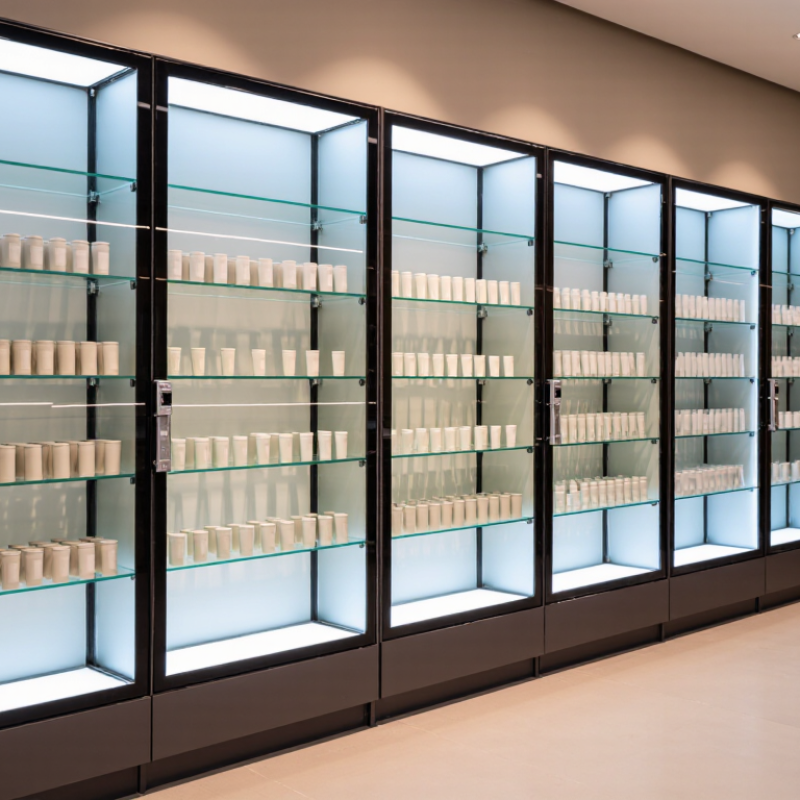
Practical design matters on busy retail floors. A case with adjustable shelves can hold different package sizes without wasted space. Soft lighting improves visibility, while anti-glare glass keeps labels readable. Strong hinges and concealed locking systems reduce daily handling risks. Materials should also tolerate frequent cleaning. Metal edges may look durable, but they can feel cold and institutional. Warm finishes often create a more approachable setting. We have found that customers notice poor lighting quickly. Retailers sometimes overfill displays, which weakens trust instead of building it.
Tips: Keep regulated products behind locked glass and place compliance information at eye level. Leave space between items for clearer viewing. Measure doorways before ordering large cases. Ask local authorities to review the layout. A beautiful fixture cannot correct an unclear operating process. Sustainability also deserves attention. Reusable panels, replaceable hardware, and low-energy lighting may reduce long-term waste. Yet these choices need honest evaluation, because a “green” finish is not automatically a responsible one.
China Best Dispensary Display Cases for Global Retailers - Map Demand: UNODC Recorded 228 Million Cannabis Users in 2022
Verified cannabis-market indicators and practical display-case planning considerations for compliant retail environments.
| Market Dimension | Geography / Period | Verified Data Point | Retail Display Implication | Source |
|---|---|---|---|---|
| Global demand | Worldwide, 2022 | 228 million people were estimated to have used cannabis, making it the most widely used controlled substance globally. | Global retailers need modular display systems that can be adapted to different product categories, legal requirements, and store formats. | United Nations Office on Drugs and Crime, World Drug Report 2024 unodc.org |
| Use prevalence | Worldwide, 2022 | The estimated 228 million cannabis users represented approximately 4.4% of the global population aged 15–64. | High-traffic retail locations benefit from clear product segmentation, easy-to-read information panels, and secure visibility without open customer access. | United Nations Office on Drugs and Crime, World Drug Report 2024 unodc.org |
| Adult-use legalization | Uruguay, since 2013 | Uruguay became the first country to establish a national legal framework regulating the production, distribution, and sale of cannabis for adult use. | Retail fixtures should support controlled product presentation, restricted access, and clear separation between informational displays and purchasable products. | Government of Uruguay, Law No. 19.172 impo.com.uy |
| Mature regulated market | Canada, since October 17, 2018 | Canada implemented a federal framework for the legal production and sale of cannabis for non-medical purposes. The minimum legal age varies by province or territory, generally from 18 to 21. | Display cases should allow configurable locking, age-restricted access, durable glazing, and adjustable shelves for different package sizes. | Government of Canada, Cannabis Legalization and Regulation canada.ca |
| European regulatory change | Germany, April 1, 2024 | Germany's Cannabis Act allows adults to possess up to 25 grams in public and cultivate up to three plants for personal use, subject to statutory conditions. | European retail concepts should prioritize compliance signage, secure storage, product education, and flexible layouts that can respond to changing national rules. | German Federal Ministry of Health, Cannabis Act Information bundesgesundheitsministerium.de |
| Display planning benchmark | Global retail planning | A practical planning range for a lockable countertop display is approximately 600–1,200 mm wide, with adjustable shelf spacing of approximately 250–350 mm. | This range can accommodate small packaged goods, educational samples, accessories, and point-of-sale information while preserving visibility and controlled access. | Planning specification for retail fixture design; dimensions should be validated against local fire, accessibility, security, and licensing requirements. |
| Security requirement | Regulated retail environments | Retailers operating under controlled-substance rules commonly require restricted customer access, inventory control, and secure storage procedures; exact requirements vary by jurisdiction. | Recommended features include commercial-grade locks, laminated safety glass, concealed hinges, tamper-resistant hardware, and provisions for anchoring the case to a counter or floor. | Local laws and licensing authorities should be treated as the controlling source for final fixture specifications. |
Note: Cannabis laws, age limits, possession rules, packaging standards, and retail-display requirements differ by jurisdiction and may change. Retailers should verify the current requirements in each target market before installation.