Why Choose Aluminum Storm Doors for Global Buyers?
Global buyers are looking for storm doors that balance durability, energy performance, appearance, and manageable maintenance. Aluminum storm doors meet this demand with lightweight frames, corrosion resistance, and broad design flexibility. A properly fitted door can create a practical buffer between indoor spaces and wind, rain, dust, or sudden temperature changes. Small details matter. Think of a powder-coated frame, replaceable screening, and a tight sweep along the threshold.
Industry evidence supports this direction, although it requires careful interpretation. The International Aluminium Institute reports that recycled aluminum can save up to 95% of the energy required for primary aluminum production. This gives aluminum storm doors a meaningful circular-economy advantage when manufacturers use verified recycled content and responsible processing. The International Energy Agency’s Energy Efficiency 2023 analysis also emphasizes the importance of reducing building energy demand through better envelopes and efficient components. Doors are only one part of that envelope, but weak seals can undermine stronger walls and windows.
Performance still depends on installation quality. A premium frame cannot compensate for poor alignment, thin glazing, or missing drainage paths. The U.S. Department of Energy consistently identifies air leakage and weatherization as important factors in building efficiency. That makes specification essential for global buyers. Check tested air infiltration, water resistance, hardware quality, coating standards, and replacement-part availability.
Aluminum is not automatically the best choice.
Some coastal environments need enhanced finishes and stainless-steel hardware. Some homes need thermal breaks or insulated panels. Buyers should compare regional climate data, certification documents, warranty terms, and installer experience before choosing aluminum storm doors. The strongest decision is practical, documented, and slightly skeptical.
What Are Aluminum Storm Doors?
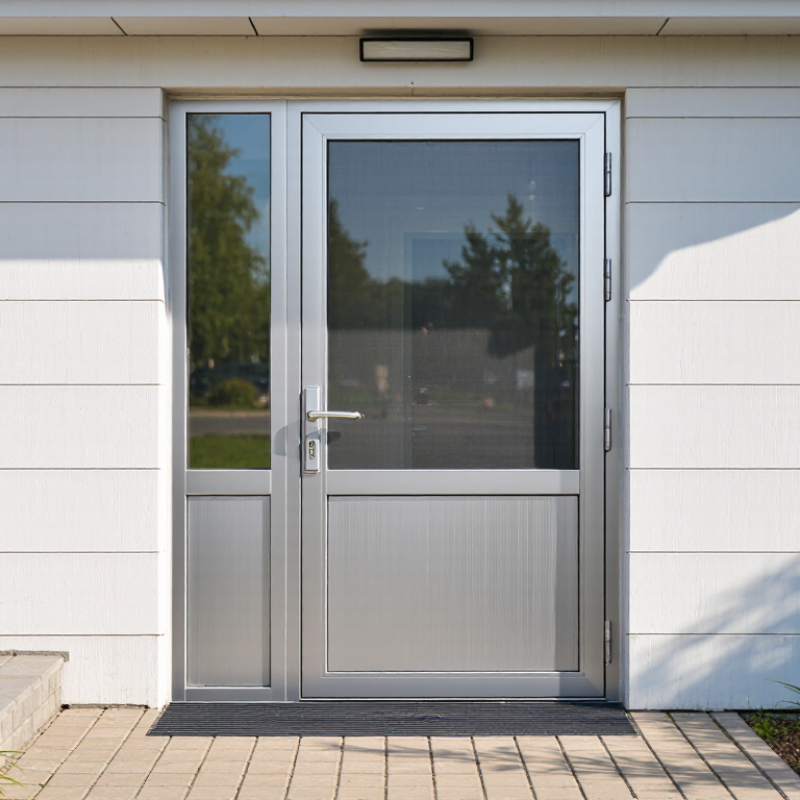
Aluminum storm doors are secondary exterior doors installed in front of a main entrance door. They usually contain an aluminum frame, glass panels, screen inserts, hinges, handles, and weather seals. Their main purpose is to reduce exposure to wind, rain, dust, insects, and daily temperature changes. They are not a replacement for a certified primary security door.
The aluminum frame is lightweight but reasonably strong. It resists rust better than ordinary steel, although salt air can still damage finishes and hardware. In coastal regions, buyers should check the coating quality, drainage openings, and fastener materials. A well-fitted door should close evenly, leave no visible gaps, and keep the glass stable during movement. I have seen poor installations cause rattling, water entry, and early seal failure.
Glass and screen options also affect practical performance. Clear glass improves daylight, while removable screens support ventilation in warm seasons. Tempered safety glass is often a sensible choice for residential projects. However, thicker glass does not automatically mean better protection. Frame design, hinge strength, installation accuracy, and local wind conditions matter more than appearance alone. Global buyers should confirm opening measurements, climate requirements, replacement parts, and maintenance instructions before ordering. Aluminum doors need care, too. Dirt can block drainage channels, and loose screws can worsen vibration. They are useful products, but not perfect ones.
How Aluminum Storm Doors Are Designed and Manufactured
Why Choose Aluminum Storm Doors for Global Buyers?
How Aluminum Storm Doors Are Designed and Manufactured
A reliable aluminum storm door begins with climate and usage data. Manufacturers select corrosion-resistant alloys, then extrude profiles with controlled wall thickness. A thinner frame may reduce weight, but it can weaken stiffness. This trade-off deserves careful review.
Designers add tempered glass, adjustable screens, compression seals, reinforced corners, and drainage paths. These details manage wind, rain, insects, and daily impact. The U.S. Department of Energy reports that windows can account for 25–30% of residential heating and cooling energy use. A well-fitted storm door may support better comfort around the entry area, although results depend on the existing door and installation quality.
Production usually includes extrusion, cutting, punching, surface treatment, assembly, and inspection. Powder coating improves surface protection, but poor pretreatment can still cause early failure. Quality teams may reference ASTM E283 for air leakage, ASTM E331 for water penetration, and ASTM E330 for structural performance. The International Aluminium Institute reports that recycled aluminum requires about 5% of the energy used for primary aluminum production. That figure encourages responsible material planning, not careless recycling claims.
Tips: Ask for alloy details, coating specifications, glass safety data, test reports, drainage drawings, and installation tolerances. Check hardware movement after repeated opening cycles. Small alignment errors matter. Suppliers should also verify packaging for humid sea freight, because corner damage is common and often underestimated.
Key Benefits for Global Buyers
Why Choose Aluminum Storm Doors for Global Buyers?
Key Benefits for Global Buyers
Aluminum storm doors offer a practical balance of strength, weight, and weather resistance. Global buyers often choose them for homes, apartments, offices, and coastal properties. The material does not rust like untreated steel. This matters where salt air, heavy rain, or seasonal humidity can damage exposed metal.
Installation is usually easier because aluminum frames are relatively light. A two-person crew can handle many standard units without special lifting equipment. Powder-coated surfaces also reduce repainting needs. However, coating quality matters. Poor preparation may cause fading, peeling, or early corrosion around drilled holes. Buyers should request finish specifications, salt-spray testing, and clear maintenance instructions.
Energy performance deserves careful attention. A properly fitted storm door can reduce drafts and support indoor comfort during hot or cold seasons. Weather seals, adjustable thresholds, and secure hinges often matter more than appearance alone. Measurements must follow local building conditions, including unusual wall depths and threshold heights. Small errors can create air gaps.
Not every aluminum door suits every climate. Thin frames may feel less rigid in high-wind areas. Glass selection also affects weight, safety, and insulation. Ask suppliers for hardware details, packaging standards, replacement-part availability, and installation drawings. Reliable documentation makes international purchasing less uncertain. Buyers should also check local code requirements before ordering large quantities. That step is easy to overlook.
Why Choose Aluminum Storm Doors for Global Buyers?
Aluminum offers a strong weight advantage over carbon steel, helping reduce handling, shipping, and installation demands. Its higher thermal conductivity also supports efficient heat transfer when used with insulated designs and thermal breaks.
Representative engineering values: aluminum density approximately 2,700 kg/m³ and thermal conductivity approximately 205 W/m·K; carbon steel density approximately 7,850 kg/m³ and thermal conductivity approximately 50.2 W/m·K. Actual values vary by alloy, coating, and construction.
How to Select the Right Aluminum Storm Door Supplier
Why Choose Aluminum Storm Doors for Global Buyers?
Aluminum storm doors suit global buyers who need light weight, corrosion resistance, and dependable daily protection. Their frames are easier to handle during installation than many heavier alternatives. However, the door performs only as well as its supplier’s process. Selecting the right aluminum storm door supplier requires more than comparing unit prices.
Look for a supplier with documented material specifications, consistent profile thickness, and controlled surface treatment. Ask for recent production photos, test records, and a physical sample. Check how the hinges, seals, screens, and locking points fit together. In my experience, small gaps around the frame often reveal weak quality control. A reliable supplier should explain packaging methods, lead times, inspection steps, and replacement procedures clearly. Vague answers deserve caution. No supplier is perfect.
Tips: Compare samples from at least two suppliers. Measure frame alignment, coating uniformity, handle movement, and seal compression. Confirm whether custom sizes require new tooling or only cutting adjustments. Request clear tolerances in writing. Also review communication speed, because delayed replies may become costly during production changes. A low quote can hide thinner aluminum, fragile hardware, or poor export packaging. Reflect carefully before choosing. Steady evidence matters more than attractive promises.